Pub Battles is experimenting with new terrain rules. There is no longer a one third movement reduction for entering cover. Terrain effects on combat and LOS have not changed, and road movement rates still apply.
Kriegspiel, from which Pub Battles was modeled, does not use varied terrain costs. It was felt unnecessary.
Once again, in Pub Battles the chit draw moderates everything. Are you racing your opponent to a a critical point on the map? You are not moving a squad of men across a street, you are ordering 4-6,000 men, horses, and equipment, over a mile across uncertain terrain with unknown enemy countermoves. Yes, terrain will factor into the equation of how far the block of troops can move, but it is only one of many limiting factors.
Are the orders clear and understood? What if there are considerations or recent developments the commander was unaware of? What if there is some terrain obstruction that does not appear on any map? What if a nearby enemy formation gets the jump on you? How will you react?
How can a playable game possibly model all of those circumstances? Does it make sense to pick out one factor (terrain) and make it the only consideration? Terrain is often selected because it is the most obvious, but does that make it best?
I submit that the chit draw does a better job of regulating movement and maneuver between two armies. Of course, all this discussion is merely discussion. How does it play?
When Command Post Games first asked me to play test this, I thought “What the hey? No way! This won’t work! “Try it” they said. So I tried it.
Having played many games this way, I can assert with confidence that it plays more smoothly, allows more maneuvering, and that it doesn’t “break” anything. Switching formations in and out of march column, as well as changing facing, still costs the same. A block still has to be within command range if it wishes to contact an enemy block. All you are really gaining is an additional third in most situations, yet I feel as if the training wheels have been taken off. Without this change, terrain and maneuver players are often reduced to moving one third of a movement stick. Now I call playing that way “The Battle of Molasses”
I didn’t know that if you ordered a paper map, it comes folded in a box. I had to get a copy and check it out. If you prefer to store your games on a shelf, and are willing to pay less 😀 for a less durable than canvas map, this could be a viable option.
Watch this video to enter the giveaway. Eligible comments must be left in the YouTube video comments!
I have been tasked with leading the creation and play testing of Pub Battles’ Second Battle of Bull Run. I wanted to share where this is at, so far.
The OB
Developing the Order of Battle for a Pub Battles scenario is, like almost every part of the Pub Battles design, a lot of work to create an otherwise simple appearance. Since every component has a lot of wiggle room (one infantry block can represent anywhere from 3000 – 6000+ troops) it would seem a quick task to whip something up.
Well, yes and no.
It is relatively straightforward to fit the general numbers with the blocks. The trick is coming up with the right feel. You start with a Corps, everything is based off the Corps. How many troops did the Corps have at the battle? When might the disparate parts of the Corps gel into the whole? Where were they, and where might they have been?
This is where it starts getting tricky. The Second Battle of Bull Run really began with skirmishing almost a week ahead of the final day of the battle. Most of that involved two armies groping around trying to find each other. This makes for an exciting refereed Kriegspiel game of cat and mouse, but so much can be arbitrary luck that two players might just as well guess and roll dice.
When to start?
Ultimately, after many fitful starts, it was decided to begin on the 29th of August, 1862. Everyone who could be there, was there. Players can then feed forces haphazardly into the fray while simultaneously trying to outmaneuver their opponent and gaining local numerical superiority, as Pope tried, very unsuccessfully, historically. Alternately, the Union can first gather into a coherent whole before attacking the foe they outnumber. Which is easy peasy IF Lee just sits there and patiently waits to become outnumbered.
Ah, suddenly we have a very interesting battle to recreate!
Jackson and Stuart begin on the map, West of the unconstructed railroad and South of Bull Run. Longstreet enters from the West on the Warrenton Turnpike. The Union player starts with up to 5 blocks on Henry Hill, and the rest of the army arrives from two points: From the East on the Warrenton Turnpike at Centerville, and from the South at Manassas Junction.
Strategy
This setup leaves the Union player with a lot of interesting alternatives. The Turnpike is a major road and allows the fastest entry, but it is faster yet to have some of the forces begin on the minor roads out of Manassas Junction. Also, if the Union player tries to have everybody use the same road, there are going to be traffic jams and pinch points. A Corps, or two, will very likely spend a turn or two, waiting for traffic to start moving.
By far the trickiest bit to recreate was the Union command confusion. The Union army would have been difficult to command for an able commander, with everyone working as a well oiled machine; historically, it was anything but.
It is never fun to be hemmed in by all the mishaps of one’s historical counterpart, at the same time, many battles wouldn’t have even been fought without them. This is what we have done so far, and it seems to be working quite well:
Two Corps are the original Army of Virginia under Pope’s command. Three Corps are newly added, grudgingly surrendered, Corps from McClellan’s Army of The Potomac. McClellan wanted Pope to fail so McClellan would be recalled to command of the Federal forces, and be hailed as the “Savior of the Republic!” New to the job, and having his fellow officer conspiring against him, may very well be the source of Pope’s timorous command style at Second Bull Run.
This means there are two Third Corps at Second Bull Run. The Army of the Potomac Corps still have that on their labels, to differentiate this “other” Army. Even though you have two different army labels, there is only one army, the Army of Virginia.
We have decided to incorporate the general confusion this whole mess created by first assigning all artillery, cavalry, and Baggage Trains directly to Pope, then having Pope only able to activate when one of the two chits Labeled “Army of Virginia” are drawn. He still commands all the HQs, but he only activates when either of two of the five Corps are drawn
In practice, this makes it very tough to coordinate the army as a coherent whole. It can be done, but it takes care, and is very fraught. This is exactly what we were looking for! The larger Union army is harder to maneuver into striking distance.
Conversely, if Lee just enters and turtles up on the Southwest corner waiting for Pope to exhaust himself attacking Jackson in frontal assaults, like he did historically, he is likely to be disappointed. The Southwest corner can be broken by carefully coordinated bombardments with superior numbers of artillery. Like always, Lee is facing a numerically superior foe, and must choose his ground wisely. With a map that covers over six square feet, Confederate players will have a lot of choices!
The obvious ideal choice is the Southwest corner, but much of this advantage is lost if your opponent knows that’s your plan. What merry chases will you have Jackson lead the Federal forces on?
The Feel
Having that question in mind, let us look at the flow of the battle. On the first day, one can generally expect lots of maneuvering to set the enemy up for their ultimate defeat on day two. This mimics the historic battle. Having laid out this general flow, the victory laurels will often rest on the player that deviates from the expected.
As always, with Pub Battles, the battle is fresh each time it is played, even if you follow the exact same battle plan, because the chit draw is different each time. I explain this fully in THIS POST.
New Rules
As always, we tirelessly work at even more elegant and simple rules to make the game as authentic as possible, while remaining Boom Simple!
Limited Rally Baggage Trains
Sometimes it seems a little too much when you hit a line turn after turn and the Unpacked Baggage Train rallies several spent units from a somehow unlimited supply.
Instead, what if a Baggage Train were limited to a certain number of rallies per game? We wondered what affect this might have, and after several games have found that four rallies gives the right feel (remember, Pub Battles is all about the feel).
This generally means that you can decimate the enemy, or have decimated your army, with an all out attack once or twice, and then your done. It gives a very authentic feel to managing your losses.
This is actually a two part rule change. The first part is that on a night turn, you recover all your lost blocks, except they all are placed in a spent condition, and just like you can’t move and rally in one turn, a block can’t rally the turn it is placed. The second part is the four rally per Baggage Train limit.
This rule isn’t official yet, but I encourage you to try it out. You can keep track on a slip of paper, or with tooth picks, matchsticks, or dice placed by the Baggage Train block.
I like to use my 1/8″ wood bases that I also use as markers for road column. I remove a block for each rally.
Bases showing blocks in march column, and a full strength unpacked Baggage Train.
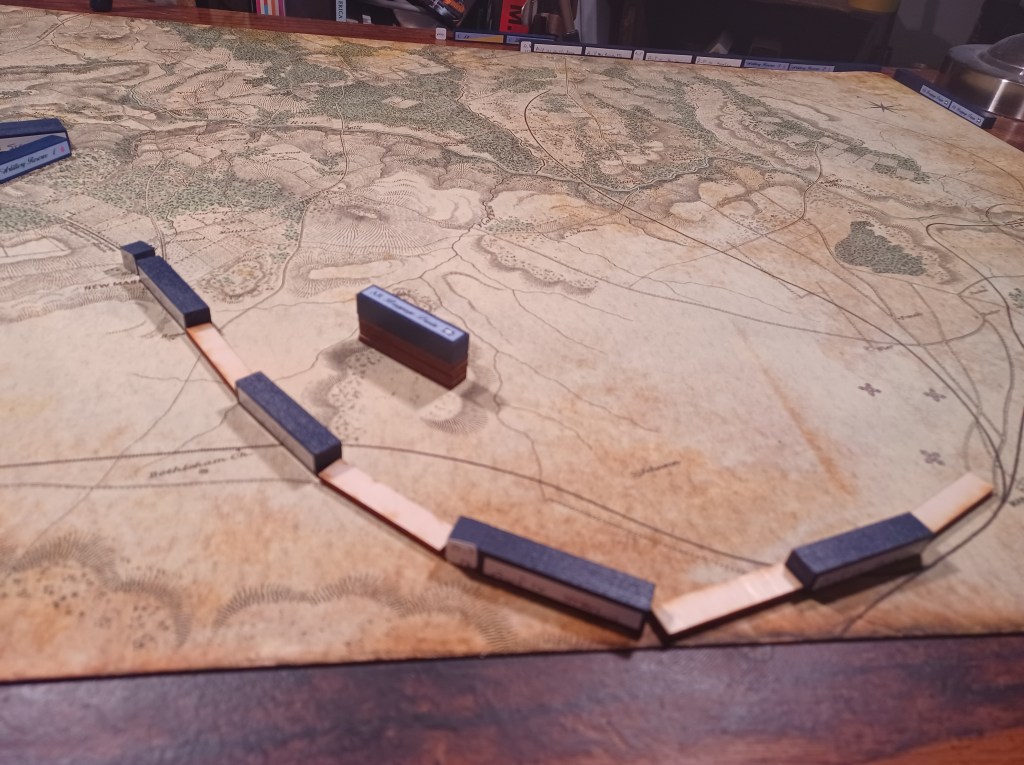
If your block is marching on a major road, you place the base on top of the block. Many folks choose to play with miniatures, just using the rules and scaling their table to their preferred base size. If you want to base 5mm or smaller figures on a base appropriate to the canvass map, these are 1/8″ thick bases of the appropriate dimensions for the system. They are available from TRE GAMES INC @ $5 for 30. They have a lot of different size wood bases as well as scale terrain and models.
CODA
This project has taken over my life. It is so exciting to work on, and it feels really good when things just work. I started this project thinking “This’ll never work,” this battle isn’t really suitable for Pub Battles. Trial after trial, replay after replay, it was cool to see how well the system captured the feel of the greater battle. Now, I can’t even remember why I thought it wouldn’t work, it seems ideally suited!
Finally, when reading the histories of any conflict, they are mostly focused on much smaller units and actions; yet after playing the scenario, I could imagine those same actions as part of what “the game” was telling me as I played.
I should add that Second Bull Run is simply an add on to “Bull Run: The Big Skedaddle.” It uses the same map, you only buy the new blocks. A very economical way to get what is essentially, a whole new scenario. The map is the same, but very different troops fight a very different battle.
Coming soon! Subscribe to my blog and get a heads up when it is available.

 Boom Simple Musket Battles
You must be logged in to post a comment.