Kriegspieling Musket Battles

It is possible to have an experience very close to actual Kriegspiel with Musket Battles.

One of the coolest ways to play Musket Battles is by mobile (cell phone, here in the US), or e-mail.

In its simplest form, it requires 3 people. Two players, who only need the orders maps available form the Command Post Games Website, and a Ref with a copy of the scenario. All must have mobiles. The players can each be in some remote location, at least a few barstools away, but they only need to be in cellular contact with the Ref (each could be a continent away). Actually, they could be sitting across from each other, having a convivial good time and sharing a drink. The players each draw their orders on their map, and text a pic to the ref.

The ref has the game set before him and plays the turn (the chit draw, including Alter Turn Order rolls, moves, and resolves combat). Next, after-action reports are texted to each player. The reports should not include any gamey descriptions or info! Authentic sounding reports from the field commanders are what is wanted. The reports should be addressed from the field commanders (the ref) to their Commanding Army General (players).

Of course they will contain the results of combat, but they should also contain various intel as it becomes available. Things like “dragoons spotted SW of Gettysburg.” Or “Large secesh column moving East along Baltimore Pike.” My only words of advice are that the intel should all be accurate, if not overly detailed. The players are pretty much in the dark anyway, and adding inaccurate, missing, or lost, reports, will really gum up the works. It might be historically accurate, but this way is hard enough, without adding distractions. Maybe very experienced players would enjoy the confusion, but even they will find too much ruining the experience.

Players themselves should be encouraged to add scouting notes like “Sending Dragoons West of Street Road to watch for enemy movement.” Remember that dragoons don’t have to follow orders, and can move independently. Unless they specify what the Dragoons are doing, the dragoons will follow orders! If they have no dragoons in their command, detachments may be sent up to 1/3 foot move beyond the LOA to scout. Remember to include the intel that such scouts obtain (their LOS). Once you have sent the text, give them ten minutes to send their orders back to you. You could make it less or more, but you have no control over how long it actually takes for the text or e-mail to appear. I wouldn’t go much longer than ten minutes, because 8 turns at ten minutes is 80 minutes for a game, and it will take the ref even longer to interpret the orders, play the turn, and send after-action reports back to the players. That’s three hours at least. This whole process could be done just as quickly with e-mail rather than texts, if that works better. Once players are comfortable with the process, you can cut the turn around time to two minutes. Larger scenarios with many Corps might require extra time!

The coolest part: Each turn, the ref should take a picture before combat is resolved, and after combat is resolved. After the game the ref sends the pictures to both players as a group text. Nothing is more fascinating than to compare what you were picturing the battle looking like, and what was actually happening!

Playing in public has the added advantage of inviting kibitzers who might be intrigued, and possibly adding interested folks.

Ultimately, players don’t really need to know how to play, they just need to know how to draw orders on the map. In fact, not knowing the details of the mechanics creates a more authentic experience for the players. They won’t be thinking in game terms, their entire experience is authentic.

Paperless Written Orders

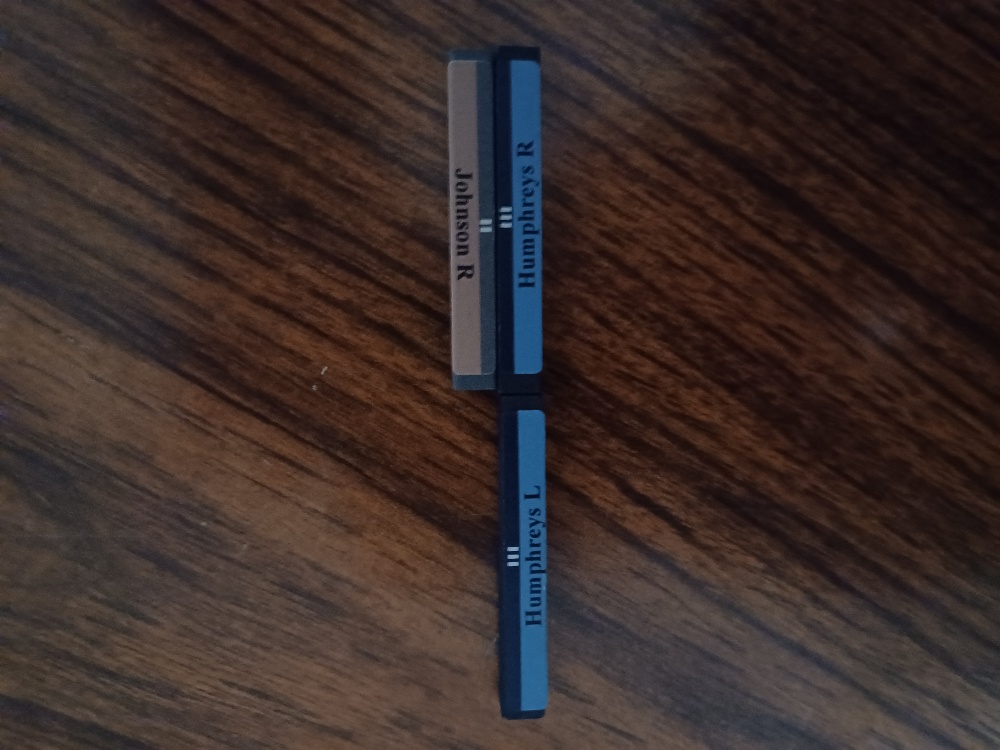
When you draw a chit, You may move your blocks, keeping the same facing (following orders). If you want to change facing (issue new orders), the HQ must flip to spent. When you are done moving the first block, its new facing indicates the new orders, and any block you move after that must end with the same facing.

You may refuse the flanks at the ends of your line.

When you attack, your block must be following orders (facing the right way) when it contacts the defending block, then you may have to adjust it to conform to the defender’s facing. You must always conform to defenders facing, and this facing change is free.

Your blocks in Road Column follow roads. Entering or leaving a road counts as changing the command’s facing, and requires issuing new orders.

You may rotate artillery to fire without changing orders.

Overlapping
A block in end to end contact with a block in combat gives that block advantage if it is not in contact with an enemy block.

Wayne is overlapping the 71st. Muhlenburg gains an advantaged die!


Two such blocks grant an additional advantage.
In the event a block has two, or more, favorable advantages than the defender, the defender uses a disadvantaged die and the attacker uses the advantaged die.

Here is a link to my video explaining the rules:

Quick and Dirty Solo variant

This is my quick and dirty solo variant for playing Musket Battles solo. I call it a variant because it is not intended to replace the 4.0 rules as printed, only to smooth playability for me when playing solo and/or recording videos. All 4.0 rules are used, except as modified below.

Combat is resolved completely, one defending block at a time, in the order chosen by the tactically dominant Army. If multiple blocks are flanking a single defender, the attacker chooses which block is the primary block, its modifiers are used, and all hits are applied to it.

Flank attack bonuses are applied for multiple attackers, as well as individual attacks to the rear. A single attacking block to the flank does not grant a bonus IV die, but the defender must use a II die (firing from the flank).

New Concept–Partial flank
If a combatant has a friendly block in side to side contact (length ways), and that block is not contacted by an enemy block, then it is considered a partial flank and the block uses a IV die in combat.

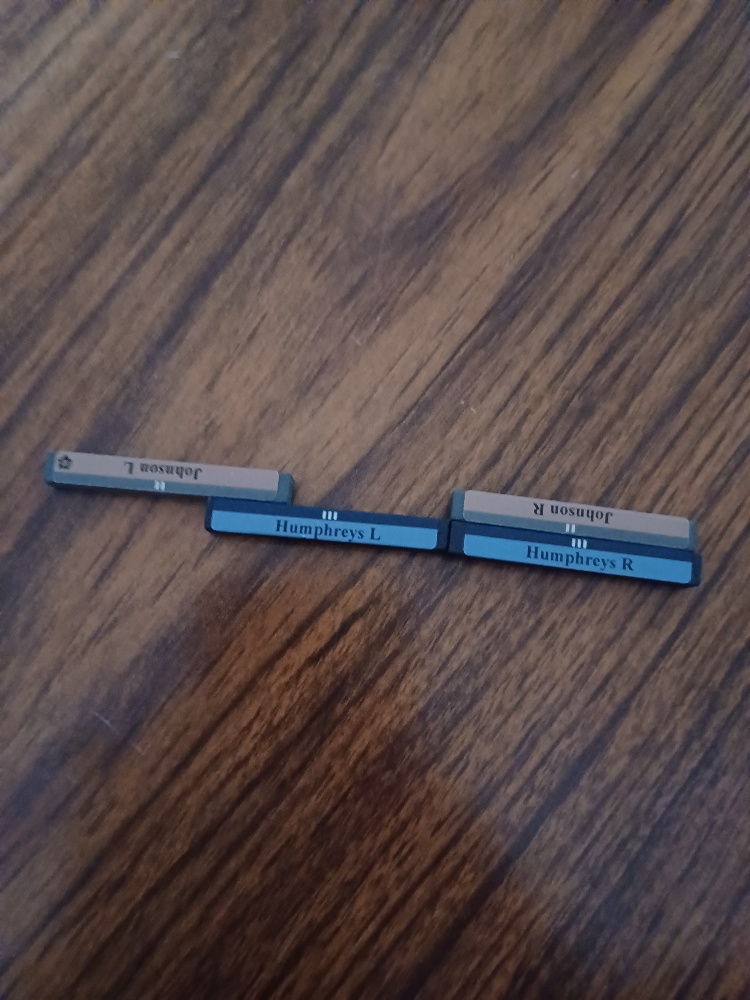
Johnson is partially flanked. Humphreys R uses the IV die. Note: it does not matter if attacking or defending.
Humphreys L cannot partially flank, it must square up with Johnson L!

Note that a block may not pass by an enemy block by claiming to only occupy half the area, that is only for moving past terrain!

Note that it does not matter if multiple blocks are flanking, other than it is that much herder to survive all the combats.

If a block ends its move in contact with the enemy, it is lined up with the enemy, the enemy block does not move.

A quicker and dirtier way to simulate orders.

A rough way to simulate the orders rules without the use of maps, if you want to get used to moving with orders limitations, is just to make all blocks end their move facing in the same direction. If you ever want to change this orientation (even if for just one block), you must flip your HQ to spent. If you roll to Alter Turn Order (thus flipping your HQ), you can not also change facing.
There are two exceptions.
1) Dragoons may move independent of any facing restrictions.
2) Blocks that use the Charge rule may charge any enemy block.

Watch hear for updates.

Pub Battles is now Musket Battles 4.0!

The latest, and probably last, version of Pub Battles is now available. The name has been changed to Musket Battles, the 4.0 version of the rules is mostly the same, and now you can specify whether you want Divisional blocks (2″ wide) or Brigade (1″ wide) blocks. For all the latest news and info, check out my Facebook page “Musket Battles Fans.”

For the posts to long for Facebook, or possibly evolving, I will still use this blog format, with links from the Facebook page.

Here are the changes and updates to the rules that I have found so far:

Dangerous dice.

Upon review, I’ve noticed that the new dice are deadlier than the old method. Even if firing with disadvantage you have a pretty good chance of doing damage (1/3 miss, 1/3 hit, one third two hits). On the other hand, the only way to get 3 hits is to have advantage (1/6).

This should make combat much quicker. More combats with brigades, but fewer rounds of combat.

A unit with a flank attack (Charlie, take your brigade and sneak around the woods there, and hit’em right when we attack) can’t miss, does 2 hits 50% of the time, and has a 1/6 chance of dealing 3 hits.

In 4.0, “Ineffective” returns. A Command that has taken 50% losses can no longer rally.

This was in 2.x, but not 3.x. It was dropped because it rarely got remembered. It’s still a good rule.

Victory conditions don’t really change, but they are explained more fully. This is the same with night turns.

Finally, the Orders rules are included as optional, and are explained more clearly and succinctly.

4.0 has “bloated” from 8 to 10 pages.😄 Roughly one page is the optional orders rules, and the rest is mostly taken up to explain rules more clearly, plus cool period art bits!

As stated in the rules, individual Baggage Trains now come on two blocks that must remain adjacent to each other. Think of them as flexing in the middle.

I had missed this, and was moving them around independently. This isn’t the case in Brandywine (they only use one block), but in Antietam every command with a Baggage Train, has two.

DIY guidelines

These guidelines are newly created and will be used for a series of videos. I will update it as playtesting necessitates.

1) Pick a map.

2) Pick the defenders LoC (must be a major road leading off an edge).

3) Pick two enemy armies, the larger number of blocks is the attacking army.

The defender may set up anywhere beyond one mounted move of the enemy’s edge.

The defender must prevent the attacker from being within command range of their LoC at the end of the day.

Either side may withhold any number of Corps (or individual dragoons) to enter on later turns (specify Corps and turn) as reinforcements. On the appropriate turn the chit is added to the cup. The enters on a road either on its own edge (E), or one of the side edges (S). The first reinforcement drawn from the cup enters by road along which ever edge was specified. Once a Corps enters on a side, that side becomes the edge that all friendly S Corps enter on, and any subsequent Enemy Commands  with an S must enter on the opposite edge. A side without a road may not be selected. If no eligible side remains, the reinforcement must use its E side. 

Variation: Meeting engagement. Both Armies armies enter on their home edge along one road on turn one in column, unless specified to enter later as a reinforcement.

Variation: Fog can be determined to reduce visibility to 1/3 foot move. If you want to use fog, roll a die each turn before the chit draw. If you roll the less than the turn number the fog clears. If a 5 or 6 is rolled on turn 1, there is no fog.

Note that this could create a very different Gettysburg, even if the historical Armies and home edges were used. Brandywine could find Washington on the Pratzen!

War Campaign: Play the same armies, keep track of victories. Play 5 battles. After the first battle, the winner of the previous battle is the attacker. If the defender is a larger army by number of non HQ and detachment blocks, it must remove complete HQs until it has the smaller force.

Even if you own just one scenario and map, this should provide numerous variations.

Let me know what you think, or if you think I have missed something!

The Austerlitz Variation

Austerlitz, that amazing Napoleonic victory, is a fraught endeavor to simulate in a game because the whole battle is predicated on a deception, without which the battle would never have occurred. Napoleon needed to convince the Coalition forces that he was weaker than he was so they would leave their secure position on the Pratzen and attack, wherein he could descend with his actual force at hand and defeat them.

As the Coalition forces player, you know the truth of the matter, and you are not going to be fooled this time. The trick as a game designer is how to simulate this deception. As a soloist, this is an even trickier problem. The simplest solution is to play as if the coalition thought they were facing a much smaller force, until the jig is up, and then you have them scramble to react to the full strength force. This is actually entirely satisfactory, and fun. But it leaves out the feel of the historical battle, and Pub Battles is all about the feel of the battle. How did it feel to be the Coalition command staff, and not know what you were facing?

The Published version of Austerlitz works well for 2 players and teams, what I am suggesting here is for solo play specifically, but it works for 2 player games as well.

I came up with a solution for myself playing solo, but in the process I came up with a solution for competitive play as well. Here’s how:

Neither side knows Napoleon’s real strength until it’s too late. In order to win, Napoleon must play as if he has his full strength, and the Coalition must play as if he does not! This is done by not determining if Napoleon’s full strength is present until the optional troops are within LOS of coalition forces. In that moment a die is rolled, and on a 3 or less his full strength is present, otherwise only Lannes and Soult are there.

As per the Published scenario rules, if Napoleon has his full strength, the Coalition wins a draw. Conversely, if the French only have Soult and Lannes’ Corps present, the French win a draw. In either event, one side must win, or they lose, there is no final draw result. From the very beginning, both sides are in it to win it.

The Fog of Austerlitz — One of the reasons that this works as well as it does is that a thick fog covered the battlefield all morning reducing visibility to one third of a foot move. This allows the French forces to hid their true strength much more easily. In fact, it is an interesting problem for the French. Do they reveal their strength early so they know what kind of battle they are fighting, or hold off until the last moment and get maximum advantage from the reveal, whatever may be?

With the Orders Rules — I’m playing with the Beta orders rules. The essential thing you need to know for this battle is that to change orders requires a successful command roll. That means you roll equal to or less than your command rating. For the French it is 4, and for the Coalition it is 2. A 4 command rating means that you’ll succeed two thirds of the time, and a 2 command rating means you’ll fail two thirds of the time.

This means that it is harder for the Coalition to change their orders, and much easier for the French. This means the French can issue orders that might need to be changed with little concern, whilst the Coalition army is going to have problems deviating from the initial plan.

You can imagine how these two armies feel very different to command at Austerlitz!

Playing Pub Battles Kriegspiel style.

The first time I played Double blind Pub Battles with a ref, I instantly felt how cool playing Kriegspiel can be. Just that uncertainty, moderated by an umpire, made me feel that THIIS was what no other wargame ever delivered. All the game’s mechanics are invisible to the players. There I was, sitting looking at the map with next to no knowledge as to what my troops were encountering, or where the enemy was.

Like Kriegspiel, the players should never come into contact with any game mechanic. Those are all the province of the ref. All the player does is get sit-reps from the judge (this is what you know, from your command tent), from which they issue orders. All the army commander sees on his map is his Corps HQs, and some limited intel on enemy positions and activities. He can send reinforcements to the Corps, either as a whole Corps, or a single bock (writes orders telling one HQ to send X blocks to another HQ). You would see the refs using Command ratings all the time, not for ATO attempts, but just to see if the orders are understood, or if the HQ does the right or wrong thing. Any time he is trying to decide whether an HQ could/would react to something, he could just roll a die and let fate decide. Maybe there is an exposed flank that requires a block to turn and maneuver a little to reach, do they do that? It isn’t strictly within their orders, would the commander see the opportunity? Roll a die. I think it would be great fun. The players just have paper maps to draw on. The actual map is in front of the ref, who is essentially playing the game solo with written orders. Not trying to “win” the game, just enjoying watching the battle unfold.

One caveat, at least initially, is to keep it simple. Two opposing players and a ref. Their actual locations could be in the same Pub, or the other side of the world. The ref could be playing it out, in a pub, or even better, at his FLGS with a dedicated cadre of interested kibitzers. I think this would be a fascinating game to watch. Being Pub Battles, it would move fast.

My personal opinion is that outside of a military training school where you have an almost unlimited number of participants, trying to incorporate individual Corps commanders is too ambitious. They do each need actual maps and units. You also want to have runners delivering orders. Plus, how do you keep players in a quiet sector engaged while other players in an active area of the battlefield are having a blast? The Jackson commander at Antietam is facing a full Union attack on the extreme Confederate left, while Longstreet guards the lower bridge, as per his orders. 

The ref would be rolling to ATO, trying to carry out the orders given. It would be a very interesting way to play “solo.” Essentially, three people playing solo, together!

Imagine Antietam, for starters. Lee would set up first on the main map, and mark his own map. Then McClellan would do the same. Neither would see the main map until after the battle. You could take pictures at the end of each turn, to show to them after the battle. That would be really fun for them to see. During the game you could have them sit at opposite sides of a table with a screen between them. That way you could walk over and hand them each the Sit rep for their commander, give them however long to write their orders, and then go back to play out the turn on the map and write new sit reps.