Playing Pub Battles Kriegspiel style.

The first time I played Double blind Pub Battles with a ref, I instantly felt how cool playing Kriegspiel can be. Just that uncertainty, moderated by an umpire, made me feel that THIIS was what no other wargame ever delivered. All the game’s mechanics are invisible to the players. There I was, sitting looking at the map with next to no knowledge as to what my troops were encountering, or where the enemy was.

Like Kriegspiel, the players should never come into contact with any game mechanic. Those are all the province of the ref. All the player does is get sit-reps from the judge (this is what you know, from your command tent), from which they issue orders. All the army commander sees on his map is his Corps HQs, and some limited intel on enemy positions and activities. He can send reinforcements to the Corps, either as a whole Corps, or a single bock (writes orders telling one HQ to send X blocks to another HQ). You would see the refs using Command ratings all the time, not for ATO attempts, but just to see if the orders are understood, or if the HQ does the right or wrong thing. Any time he is trying to decide whether an HQ could/would react to something, he could just roll a die and let fate decide. Maybe there is an exposed flank that requires a block to turn and maneuver a little to reach, do they do that? It isn’t strictly within their orders, would the commander see the opportunity? Roll a die. I think it would be great fun. The players just have paper maps to draw on. The actual map is in front of the ref, who is essentially playing the game solo with written orders. Not trying to “win” the game, just enjoying watching the battle unfold.

One caveat, at least initially, is to keep it simple. Two opposing players and a ref. Their actual locations could be in the same Pub, or the other side of the world. The ref could be playing it out, in a pub, or even better, at his FLGS with a dedicated cadre of interested kibitzers. I think this would be a fascinating game to watch. Being Pub Battles, it would move fast.

My personal opinion is that outside of a military training school where you have an almost unlimited number of participants, trying to incorporate individual Corps commanders is too ambitious. They do each need actual maps and units. You also want to have runners delivering orders. Plus, how do you keep players in a quiet sector engaged while other players in an active area of the battlefield are having a blast? The Jackson commander at Antietam is facing a full Union attack on the extreme Confederate left, while Longstreet guards the lower bridge, as per his orders. 

The ref would be rolling to ATO, trying to carry out the orders given. It would be a very interesting way to play “solo.” Essentially, three people playing solo, together!

Imagine Antietam, for starters. Lee would set up first on the main map, and mark his own map. Then McClellan would do the same. Neither would see the main map until after the battle. You could take pictures at the end of each turn, to show to them after the battle. That would be really fun for them to see. During the game you could have them sit at opposite sides of a table with a screen between them. That way you could walk over and hand them each the Sit rep for their commander, give them however long to write their orders, and then go back to play out the turn on the map and write new sit reps.

A Quality Leader Idea

I was thinking about an idea I had a while back for different quality leaders. A note re: my shorthand. ATO = Alter Turn Order. The roll you make to delay, or jump ahead in the chit draw.

Poor leaders must roll to activate when drawn. If they fail, they don’t move. They can’t roll to ATO.

Average leaders act just like the current rules.

Great Leaders can roll to ATO, even if they have already moved. After all chits are drawn, still fresh Great leaders can roll to move next, for a double move within the turn!

This could allow for finer gradations. A poor leader with a five rating couldn’t roll to ATO, but he could at least usually move (Longstreet?). A poor leader with a poor rating could be Porter, or Lew Wallace, who weren’t able to get their troops where they were needed. A Great leader with a low rating could represent a leader who wasn’t necessarily great strategically, but was charismatic enough to occasionally get extra effort from his men (McClellan?). Then you have those rare Great leaders with a 4 or 5 who were battle changing (Napoleon, Lee). Almost superhuman, but they can’t be everywhere! Suddenly, the French army, with Napoleon (and the Guard), becomes a force to fear. Feeling very different from a French force without Napoleon. Joe Johnston or Braxton Bragg could never quite get the results that R. E. Lee got. A Great army leader could move a Poor leader’s Corps twice in a turn, or once in a turn if the original poor leader’s roll had failed. Of course, since poor quality leaders generally commanded poor quality troops, it would usually require a crisis to want to use a Great leader in that capacity.

Note you could also have leaders with a 6 rating, meaning they are automatically successful once a turn. So a Poor leader could always move when drawn, but never ATO. An Average leader could always ATO, once per turn. A Great leader could always ATO once per turn, even if he moved before.

I could really see this working in a campaign game, as well. Imagine McClellan as a Poor leader with a 2 rating, his Armies would rarely move! Or Corps leaders who didn’t have confidence in their Army Commander, like the Army of Potomac Corps leaders under Pope at Second Bull Run.

Imagine if you did the same for Victory points. After all regular Victory calculations are finished to determine Winners normally, repeat one more time with the base victory points, but Great Leader army commanders divide by 2, Average Leaders use the basic number, and Poor Leader army commanders multiply by 2. So the Union might lose Antietam, but the Union Player might have done well with what he had to fight with, considering.

Gettysburg Day 3 with Video (coming soon)

Gettysburg historical setup for the 3rd day.

The 3rd day at Gettysburg presents some interesting tactical, operational, and strategic questions for Lee. A simple battlefield analysis shows that he is outnumbered and facing an opponent in entrenched positions. On the face of it, he should revert to the defensive, or even just quit the battlefield, but things are never that simple.

Lee needs a victory. His army is fatigued with endless marches in the hot midsummer sun. Every day on campaign he struggles to keep his army fed and supplied. He has finally brought the Union to battle. The army he faces has a new commander, Meade, who will only grow more experienced with time. He also needs to maintain his reputation of invincibility, because there are two more armies the size of this one roaming in the same theater.

He must win this, and win big. To do this, he has asked General Longstreet to attack the Union line beyond the peach orchard with Pickett’s fresh division. Lee feels the Union line is about to break. One more drive and the entire army will be put to flight. Longstreet is doubtful, he can anticipate nothing but the slaughter of his own men.

We know 20/20 hindsight that Lee’s estimate was wrong, but he had to do something. The day 3 scenario asks “What would you have done?”

I am going to try a version of Longstreet’s plan. He felt that the Union Supplies were just beyond the round tops, and if he could go around that flank and get at them, Meade’s army would panic.

To recreate this in game terms, I have devised a plan for getting a flank attack on the southern flank of the Union line. For this to work, I need the right chit draw. I need to be able to make this attack without fear of an immediate Union response. My intent is to drive on the southernmost unpacked Baggage Train, located behind the round tops.

My intent is to post this blog now, fight the battle, and then add the link to the video with this post. I am posting this first, so that when I publish the video on YouTube, I can link the video to this Post.

Second Manassas1

A Real Rock and Rolla!

Watch this most decisive game and see if you can spot the tactical mistakes that hastened one side’ demise. Let me know what you think they might be.

Second Manassas is due out later this year. Owning Bull Run is a prerequisite, but this will be a relatively inexpensive upgrade, since you will already have the map.

First Bull Run 3

First Bull Run was called “The big skedaddle” by contemporaries. Every unit, except Jackson’s, is militia, they seem to dissolve in combat. Commanding either of these armies takes skill and nerve! Don’t forget, I have my Pub Battles Antietam giveaway running through the month of July, at the end of this video I have a link to my video that shows how to win.

Pub Battles “Colors” 2

The original “Colors” post can be found here.

I may have jumped the gun, assuming that an additional loss step would be needed since there was not a retreat option that absorbs a Hit, but then I thought, “Why not make a retreat a voluntary way of avoiding a hit? Boom Simple. It may seem minor, but stacking 4 blocks high was a bit unstable. Three blocks High for a full strength unit is much more stable.

These are certainly not official rules! I’m merely testing out an idea.

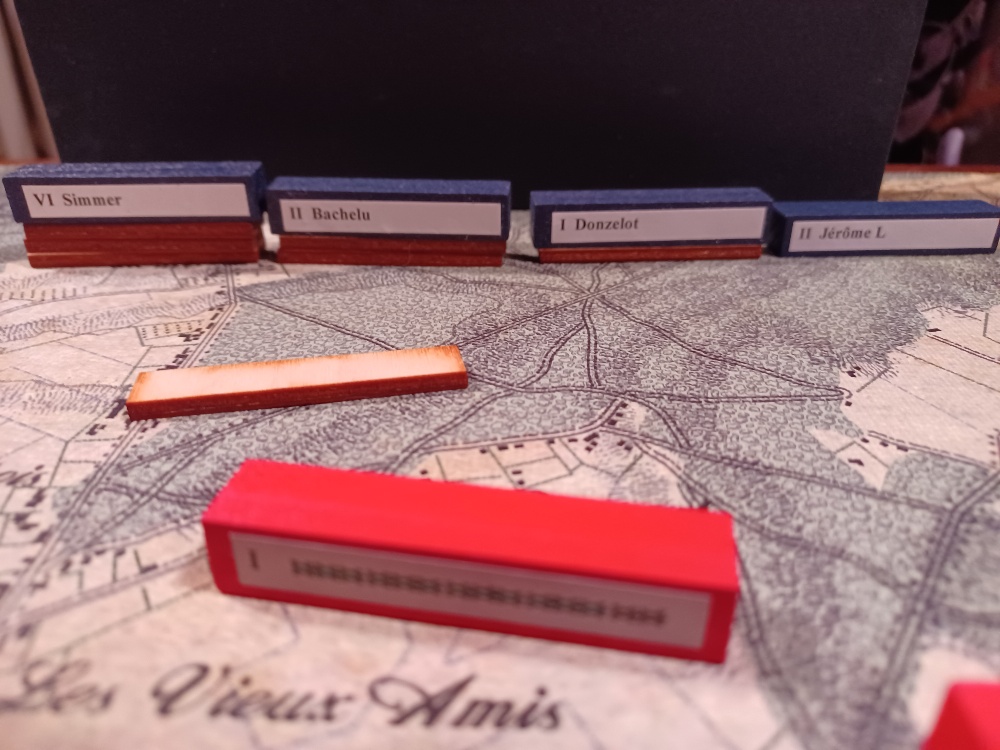
A fresh unit, a unit with two hits, and the lone Colors.

Nomenclature: A stack of blocks is called a unit. The block with the label is called the Colors. The blocks below the Colors are simply called blocks.

Combat works pretty much the same, except there is no SPENT condition, each hit suffered is tracked. Retreat is now voluntary, you may always retreat to avoid taking a hit, as long as you first suffer any hits in excess of one. Retreating units simply push back friendly units in their way. Pushed back units face the direction they were pushed.

1 Hit: You could retreat, or hold and suffer one hit.
2 hits: You must suffer the first hit and then you could retreat, or hold and suffer one hit.
3 Hits: You must suffer the first 2 hits and then retreat, or be eliminated. Sometimes, you would rather be eliminated, than push back friendly units!

Each hit removes one block, the colors are removed last. There should never be blocks without Colors on top of them.

No matter how many losses are suffered, as long as the colors remain, the unit attacks with three dice.

Bombardment: Hits from bombardment cannot eliminate Colors. Lone Colors may always retreat from bombardment.

To maintain FoW, detachments always have 3 blocks, just like a full strength unit, but they are eliminated with one hit, unless to retreat from bombardment.

Pub Battles “Colors”

Imagine if Pub Battles tracked losses more precisely, while allowing players to retreat or hold, at their own discretion. Here is a way to do that, with a smooth way of tracking losses that is Boom Simple!

This post is currently superseded by this post.

On the left is Simmer at full strength, all the way to poor Jerome who has only his colors left!

First some nomenclature: The Stack of blocks is called a UNIT, The flat pieces are called BLOCKS, and the top piece is called THE COLORS.

Combat works the same, except each hit now removes a block, retreats are not part of taking hits. After taking hits, each player has the opportunity to retreat. Retreating is always voluntary. Attacker goes first, then defender.

A unit functions normally as long as it has at least one block left. When only the Colors are left, they now act as a detachment, with one hit and one combat die.

When in range of an unpacked Baggage Train, a unit may only rally one block per turn. This means that if a lone Colors limps back into range of a baggage turn, it will take it three full turns to recover to full strength.

During a night turn, any unit that does not move may recover one block, and units within range of an unpacked Baggage Train may recover to full strength.

Clarifications:

A normal full strength unit that takes 3 hits will still have the colors left. Units with less than three blocks could lose their colors! A full strength militia unit could lose its colors in one round of combat! Essentially, Colors are just like regular blocks, except when alone and functioning like detachments. Blocks are never present without colors.