These guidelines are newly created and will be used for a series of videos. I will update it as playtesting necessitates.
1) Pick a map.
2) Pick the defenders LoC (must be a major road leading off an edge).
3) Pick two enemy armies, the larger number of blocks is the attacking army.
The defender may set up anywhere beyond one mounted move of the enemy’s edge.
The defender must prevent the attacker from being within command range of their LoC at the end of the day.
Either side may withhold any number of Corps (or individual dragoons) to enter on later turns (specify Corps and turn) as reinforcements. On the appropriate turn the chit is added to the cup. The enters on a road either on its own edge (E), or one of the side edges (S). The first reinforcement drawn from the cup enters by road along which ever edge was specified. Once a Corps enters on a side, that side becomes the edge that all friendly S Corps enter on, and any subsequent Enemy Commands with an S must enter on the opposite edge. A side without a road may not be selected. If no eligible side remains, the reinforcement must use its E side.
Variation: Meeting engagement. Both Armies armies enter on their home edge along one road on turn one in column, unless specified to enter later as a reinforcement.
Variation: Fog can be determined to reduce visibility to 1/3 foot move. If you want to use fog, roll a die each turn before the chit draw. If you roll the less than the turn number the fog clears. If a 5 or 6 is rolled on turn 1, there is no fog.
Note that this could create a very different Gettysburg, even if the historical Armies and home edges were used. Brandywine could find Washington on the Pratzen!
War Campaign: Play the same armies, keep track of victories. Play 5 battles. After the first battle, the winner of the previous battle is the attacker. If the defender is a larger army by number of non HQ and detachment blocks, it must remove complete HQs until it has the smaller force.
Even if you own just one scenario and map, this should provide numerous variations.
Let me know what you think, or if you think I have missed something!
Pub Battles is experimenting with new terrain rules. There is no longer a one third movement reduction for entering cover. Terrain effects on combat and LOS have not changed, and road movement rates still apply.
Kriegspiel, from which Pub Battles was modeled, does not use varied terrain costs. It was felt unnecessary.
Once again, in Pub Battles the chit draw moderates everything. Are you racing your opponent to a a critical point on the map? You are not moving a squad of men across a street, you are ordering 4-6,000 men, horses, and equipment, over a mile across uncertain terrain with unknown enemy countermoves. Yes, terrain will factor into the equation of how far the block of troops can move, but it is only one of many limiting factors.
Are the orders clear and understood? What if there are considerations or recent developments the commander was unaware of? What if there is some terrain obstruction that does not appear on any map? What if a nearby enemy formation gets the jump on you? How will you react?
How can a playable game possibly model all of those circumstances? Does it make sense to pick out one factor (terrain) and make it the only consideration? Terrain is often selected because it is the most obvious, but does that make it best?
I submit that the chit draw does a better job of regulating movement and maneuver between two armies. Of course, all this discussion is merely discussion. How does it play?
When Command Post Games first asked me to play test this, I thought “What the hey? No way! This won’t work! “Try it” they said. So I tried it.
Having played many games this way, I can assert with confidence that it plays more smoothly, allows more maneuvering, and that it doesn’t “break” anything. Switching formations in and out of march column, as well as changing facing, still costs the same. A block still has to be within command range if it wishes to contact an enemy block. All you are really gaining is an additional third in most situations, yet I feel as if the training wheels have been taken off. Without this change, terrain and maneuver players are often reduced to moving one third of a movement stick. Now I call playing that way “The Battle of Molasses”
Pub Battles let’s you make all the fun and interesting decisions, while the system manages the endless minutia.
Pub Battles is so simple on the surface, that it seems to scream for more detailed rules. What I invariably found when I tried many of them out, was that rather than improving the game, they usually just slowed it down and didn’t improve it much.
What I include here is those few that add to the flavor of command, yet don’t load it down with endless details:
American Revolution – Light and Militia units are the only units not Spent in woods. All others are. All units get Cover. No Rally in Woods.
Napoleonic – Light and Militia units are the only units not Spent in woods. All other infantry are. No Cavalry or Artillery in Woods. All infantry get Cover in woods. No Rally in Woods.
Civil War – No units are Spent in Woods. All units get Cover. No rally in Woods.
Buildings:
American Revolution – Light and Militia units are the only units not Spent in Buildings. All others are. All units get Cover. No Rally in Buildings.
Napoleonic – No Infantry are Spent in Buildings. Cover for all Infantry. No rally for all Infantry. Artillery and Cavalry cannot enter.
Civil War – All are Spent. All get Cover. No Rally.
These little touches add a degree of historical flavor with no real rules overhead.
Blocks in European (Napoleonic) Buildings are never considered flanked.
There is no terrain cost to move.
Unsupported foot being attacked by mounted is eliminated if it must retreat.
Leadership Rule: A Corps HQ block may be positioned on top of a block to show that the block is being led personally by the Corps commander. A militia block is treated as line, a line block is treated as elite. An elite block is still treated as elite. In addition, if such a block receives 3 hits, the HQ absorbs one of the hits, and the HQ is eliminated, the two remaining hits are applied with this rule in effect. Thereafter, the Corps has no HQ and can only receive command from the Army HQ (or any HQ if Confederate).
This rule is for fun and color, and should be considered optional!
Troops of the period liked being in cover, but it was hard to exercise command and control over troops that weren’t out in the open where their officers could see them!
Most Buildings in the European theaters were stone, and towns usually had significant stone walls.
True to its central goal of being command focused, Pub Battles handles forts with great simplicity, they count as cover and can’t be flanked. Boom simple.
What if we took this a little further though, and added just a tweak?
First, a slight differentiation. Forts and Improved Positions. Improved Positions are linear, like ACW hasty works. Great versus direct assaults, but vulnerable to flanking efforts.
In true Pub Battles fashion, I wanted this to be more nuanced than a simple die modifier. I also want it to be easy to grasp. So here goes:
Forts: cover, no flanking, ignore retreat, ignore first hit.
Improved Positions: ignore retreat, ignore first hit.
Together, they are referred to as Fortifications.
Forts count as cover and can’t be flanked, same as before. Additionally, blocks in forts ignore retreat results, and ignore the first hit.
Improved Positions don’t count as cover unless they are in cover already, and they can be flanked.
Ignoring retreat results means that the hit counts as a step towards elimination, but the block doesn’t actually have to retreat.
Ignoring the first hit stacks with Elite and Militia, which means elite ignore the first two hits, and when fresh Militia suffer a hit, they ignore the retreat result.
When spent units receive a single hit, they ignore the retreat. Two hits will eliminate a spent Militia, the first hit is absorbed by the Fortifications, the second hit is the first hit the unit suffers so counts as two hits, thus eliminating it.
Due to the temporary nature of Improved Positions, I use the wooden Pub Battles bases available from TREGames. You may also have seen these used for denoting march column status in my videos. Currently, due to the experimental nature of these rules, they aren’t used in any Pub Battles scenarios, but if you DIY any late ACW battles, they would be highly appropriate.
Actual Forts could be used in any current scenarios that use Forts, Like Hougomont in the Waterloo scenario, or any European walled town.
One of the generally accepted issues with any wargame is that players have far more control over their troops than their historical counterparts could ever have dreamt of having. It is also a corollary that the best part of playing a wargame is having that control, as opposed to being a mere kibitzer.
Having said that, wouldn’t it be fun if you had a game that let you write your orders and then sit back and watch while the battle was fought, just to see how it all fell out. One can easily imagine a computer game doing this. Back in the seventies, when I was in High School, there was a text based ACW program where you were given money to buy ammo, food, and supplies for your army for a particular battle, and then, based on how you allocated that, the computer printed out the results of the battle.
That would hardly pass as a fun simulation today, but what if you had an animated battle game, where the units followed your orders and you sat back and watched how it all fell out. You could try to issue new orders during the battle, but as history has shown, that is a fraught endeavor, indeed!
I believe this can be done with Pub Battles. In place of orders written, sent, and received, the provence of true Kriegspiel, I offer a simple limited order system that removes one from the too immediate control of individual units and blocks. It requires one to have a plan and stick to it for the best chance of success, and it properly distances one from too much micromanagement. In keeping with the Pub Battles philosophy, I started with a system full of all the details I wanted to incorporate, and then I pared back to everything but the most essential. Rather than trying to see how much detail I could cram into the system, I wanted to see how few could actually accomplish the task.
It Works Like This…
Issue orders – When the Army Commander is activated, they may issue as many orders as their command rating. Write a number next to the HQ on the orders sheet. Place a die with that number on the map, this becomes the Objective.
Receive Orders – When drawn, the HQ then makes a command roll, if the die is less than or equal to the command rating, the issued orders are circled and considered received, and must now be executed. If the die roll is over the command rating the order is not received and the die roll must be attempted the following turn, until received or countermanded. The unit continues to execute the last received orders.
At the beginning of the scenario, or when entering as reinforcements on later turns, all HQs automatically receive orders.
Execute Orders – If a block moves, it must end its move closer to the Objective, unless it ends its move within command range of the objective. As per the rules (page 3), to be within command range, a unit need only be touching the edge of the range.
No Orders – A block with no orders to execute cannot move, except to retreat from combat (even voluntarily). Blocks may always rotate.
Spent Blocks – A spent block may always treat the nearest unpacked bags as its objective. Note that if it has no other objective, it will be without orders once it rallies.
Range effects on orders – HQs adjacent to the Army Commander automatically receive their orders without need for a die roll. HQs over one mounted move from the Army Commander must add 1 to their die roll.
Countermanded Orders – Once orders are sent, they remain on the order sheet until received. If a new order is sent, it will remain in queue. There is no upper limit to the number of orders in queue. Each turn the HQ must make command rolls for all orders in queue, in the order sent. The last received order in the Queue is Executed. Once received, all earlier orders are ignored (no need to roll to receive).
HQ Support – An HQ may be ordered to support another HQ. Simply write S(HQ) indicating which HQ to support. An HQ that is given a support order follows the same process as an HQ given new orders. Once the order is received, that HQ’s orders become whatever the orders are for the HQ it is supporting. Remove its chit from the cup, it now activates when the other HQ is drawn. The only functional distinction it retains in game terms is that it is still required for command control for its blocks. New orders may be sent to it, and rolled to receive when it is activated. If it receives new orders it immediately reverts to its own command, and its chit is placed back in the cup at the end of the turn, it does not move with the other command, and is treated as having no orders until drawn next turn!
Blocks from different commands may not attack the same defender, without a support order.
Defending blocks do not require an HQsupport order to support one another. Note that HQSupport is different from the support rules on page 4 of the 3.2 rules. Essentially, HQ Support is a concern primarily for attacking units, although being able to activate the same time as other defenders with the same order can be very useful.
Bombardment, since it requires no movement, does not require orders!
Discussion
The intent of these rules is not to exactly duplicate written orders. The intent is to provide a simple system to simulate the feeling of only possessing indirect control. Of seeing events happening on the battlefield that are beyond your immediate control. You cannot simply reach down like a Greek God to control the actions of the mere mortals, you can only hope and plan.
Since your opponent has no idea which of your commands is tied to which die, or how many may be tied to any particular die, there is some FoW inherent right away. Pub Battles primarily simulates FoW with the chit draw.
I intend to replace the dice with flat markers of some kind, as the dice get in the way.
The issues of lost or misunderstanding, or need for confirmation, are all simulated with the die roll to Receive.
It may seem ideal to use HQ Support to combine many commands whenever possible. This has its down sides though. The Objective is only Command range from its point on the map. Condensing your forces pretty much tips your hand and declares “I am going here!” This allows your opponent the option of allocating just enough strength to hold up your main effort long enough to strike somewhere else.
Combining against a defender is the surest way to succeed, if you can get away with it!
I was thinking about an idea I had a while back for different quality leaders. A note re: my shorthand. ATO = Alter Turn Order. The roll you make to delay, or jump ahead in the chit draw.
Poor leaders must roll to activate when drawn. If they fail, they don’t move. They can’t roll to ATO.
Average leaders act just like the current rules.
Great Leaders can roll to ATO, even if they have already moved. After all chits are drawn, still fresh Great leaders can roll to move next, for a double move within the turn!
This could allow for finer gradations. A poor leader with a five rating couldn’t roll to ATO, but he could at least usually move (Longstreet?). A poor leader with a poor rating could be Porter, or Lew Wallace, who weren’t able to get their troops where they were needed. A Great leader with a low rating could represent a leader who wasn’t necessarily great strategically, but was charismatic enough to occasionally get extra effort from his men (McClellan?). Then you have those rare Great leaders with a 4 or 5 who were battle changing (Napoleon, Lee). Almost superhuman, but they can’t be everywhere! Suddenly, the French army, with Napoleon (and the Guard), becomes a force to fear. Feeling very different from a French force without Napoleon. Joe Johnston or Braxton Bragg could never quite get the results that R. E. Lee got. A Great army leader could move a Poor leader’s Corps twice in a turn, or once in a turn if the original poor leader’s roll had failed. Of course, since poor quality leaders generally commanded poor quality troops, it would usually require a crisis to want to use a Great leader in that capacity.
Note you could also have leaders with a 6 rating, meaning they are automatically successful once a turn. So a Poor leader could always move when drawn, but never ATO. An Average leader could always ATO, once per turn. A Great leader could always ATO once per turn, even if he moved before.
I could really see this working in a campaign game, as well. Imagine McClellan as a Poor leader with a 2 rating, his Armies would rarely move! Or Corps leaders who didn’t have confidence in their Army Commander, like the Army of Potomac Corps leaders under Pope at Second Bull Run.
Imagine if you did the same for Victory points. After all regular Victory calculations are finished to determine Winners normally, repeat one more time with the base victory points, but Great Leader army commanders divide by 2, Average Leaders use the basic number, and Poor Leader army commanders multiply by 2. So the Union might lose Antietam, but the Union Player might have done well with what he had to fight with, considering.
I may have jumped the gun, assuming that an additional loss step would be needed since there was not a retreat option that absorbs a Hit, but then I thought, “Why not make a retreat a voluntary way of avoiding a hit? Boom Simple. It may seem minor, but stacking 4 blocks high was a bit unstable. Three blocks High for a full strength unit is much more stable.
These are certainly not official rules! I’m merely testing out an idea.
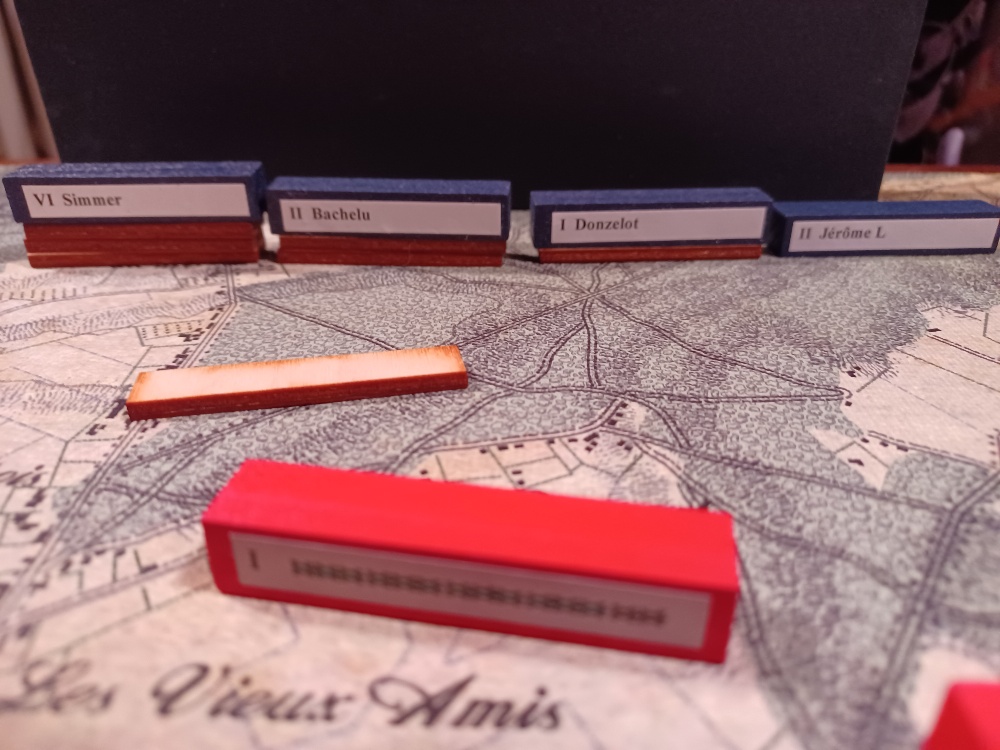
A fresh unit, a unit with two hits, and the lone Colors.
Nomenclature: A stack of blocks is called a unit. The block with the label is called the Colors. The blocks below the Colors are simply called blocks.
Combat works pretty much the same, except there is no SPENT condition, each hit suffered is tracked. Retreat is now voluntary, you may always retreat to avoid taking a hit, as long as you first suffer any hits in excess of one. Retreating units simply push back friendly units in their way. Pushed back units face the direction they were pushed.
1 Hit: You could retreat, or hold and suffer one hit. 2 hits: You must suffer the first hit and then you could retreat, or hold and suffer one hit. 3 Hits: You must suffer the first 2 hits and then retreat, or be eliminated. Sometimes, you would rather be eliminated, than push back friendly units!
Each hit removes one block, the colors are removed last. There should never be blocks without Colors on top of them.
No matter how many losses are suffered, as long as the colors remain, the unit attacks with three dice.
Bombardment: Hits from bombardment cannot eliminate Colors. Lone Colors may always retreat from bombardment.
To maintain FoW, detachments always have 3 blocks, just like a full strength unit, but they are eliminated with one hit, unless to retreat from bombardment.
Imagine if Pub Battles tracked losses more precisely, while allowing players to retreat or hold, at their own discretion. Here is a way to do that, with a smooth way of tracking losses that is Boom Simple!
On the left is Simmer at full strength, all the way to poor Jerome who has only his colors left!
First some nomenclature: The Stack of blocks is called a UNIT, The flat pieces are called BLOCKS, and the top piece is called THE COLORS.
Combat works the same, except each hit now removes a block, retreats are not part of taking hits. After taking hits, each player has the opportunity to retreat. Retreating is always voluntary. Attacker goes first, then defender.
A unit functions normally as long as it has at least one block left. When only the Colors are left, they now act as a detachment, with one hit and one combat die.
When in range of an unpacked Baggage Train, a unit may only rally one block per turn. This means that if a lone Colors limps back into range of a baggage turn, it will take it three full turns to recover to full strength.
During a night turn, any unit that does not move may recover one block, and units within range of an unpacked Baggage Train may recover to full strength.
Clarifications:
A normal full strength unit that takes 3 hits will still have the colors left. Units with less than three blocks could lose their colors! A full strength militia unit could lose its colors in one round of combat! Essentially, Colors are just like regular blocks, except when alone and functioning like detachments. Blocks are never present without colors.
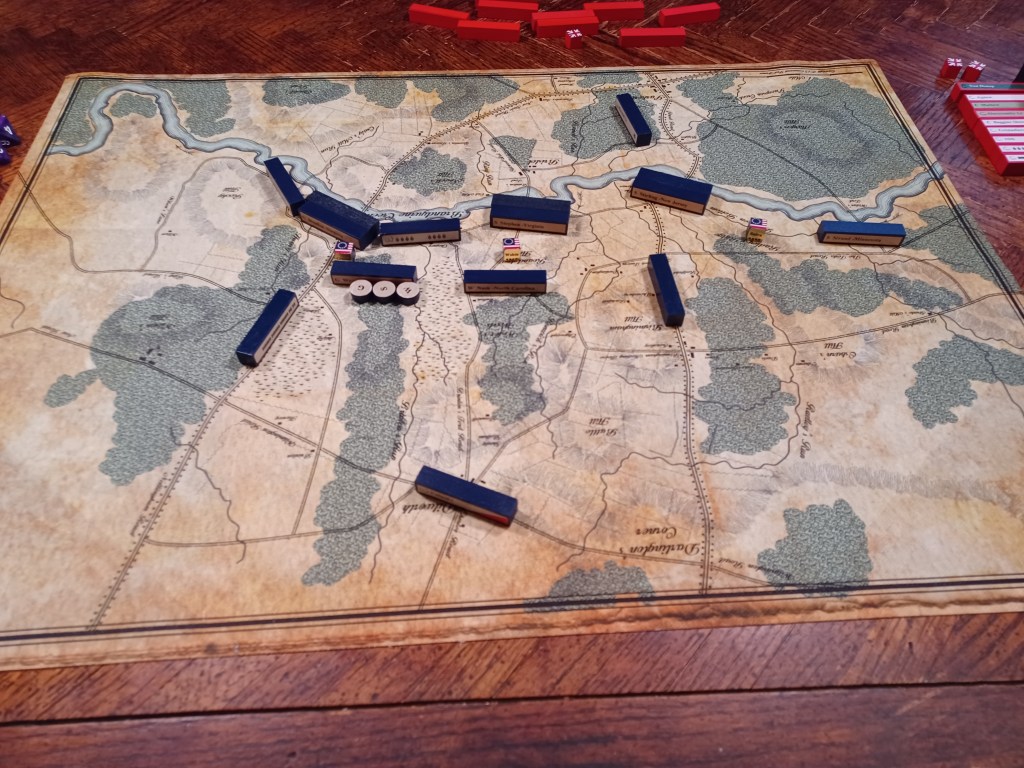
As I was setting up Brandywine this morning, I started thinking about how you could duplicate the colonial motivation for their historical, ultimately disastrous, defense. The proper way to think about it is, “Why wouldn’t the British do what they did historically.” In all my years of playing this Pub Battles scenario, I’ve never found any other entry point as successful, even if I “make” the Continentals react slowly. The British attacking across the Brandywine is the colonial hope, and attacking the other side from the historical, places you too far away for the short five turn game.
What would make Howe want to force a crossing of the Brandywine? Easier victory conditions. How might that work?
****************************************
If the British commands enter from the center, then they only need to be “Across the Brandywine” by the end of turn 8. “Across the Brandywine” means that there are no colonial troops within 1/3 of an infantry move of at least one of the five bridges. Regular victory conditions are also in effect.
Setup: Washington’s forces setup first, not closer than 1/3 foot move from any map edge.
Turn 1. One British command enters from the “Center” entry point. Note: Units may not enter in road column if this places them within 1/3 foot move of enemy forces!
Turn 2, or later. The other British command may enter from the same side as the first command.
Turn 4. If not entering earlier, the remaining British Command must enter from the Center, Left, or Right, map edge.
The British player must note secretly on paper when, and from what edge, the second command enters, before the Colonials have setup. If playing solitaire, choose a flank, and then roll randomly on turn 2 to see if the rest of the British show up then, or flank on turn 4.
****************************************
I’ll start trying to break this, to see if there is any “Sure” strategy. I’m wondering, if the British go all in on a certain crossing point, is it impossible to prevent their crossing? I am hoping that deception will play a key role in all games, are the British waiting until turn 4 to attack from the flank? Should we try to defend it? Given the possibilities, was Washington playing the only hand he had, historically? What if we used command cards? Howe and One other. Washington would need to dispatch troops to confirm the presence of the enemy on the flank! What would the British do if faced with a colonial setup of only 3 HQs?
An interesting experiment, if nothing else.
And here is my first playtest. I think this works pretty good!
I think the addition of the Baggage Train rules in Pub Battles was one of those things that just “clicked,” and suddenly everything fell into place. Gone were the days of destroyed lines suddenly appearing as fresh a turn later. Gone also, were the days of grindy combat where it was near on impossible to eliminate 50% of the enemy’s infantry blocks.
The system could stop there and be fine. Which it has. But again, what if there were a simple mechanic for showing an upper limit to how much damage one Baggage Train could fix?
After much discussion with the folks at Command Post Games, I have come up with and tested a new Baggage Train rule. It is two part:
During a night turn all blocks are recovered, but they begin as spent and may not be rallied that turn.
Each unpacked Baggage Train may rally 4 blocks per game.
While this may seem like a simple rule, as in “How much work could that be?” Its evolution through many different suggestions, all of which start out much more complex, hides the effort required to distill a complex concept down to a simple, elegant rule, that does everything initially desired.
What this means is that even after a day of heavy fighting, an army can look pretty good by morning, but it is only an illusion. The troops will be more brittle, and your lines will begin to crack and fail if asked to do it all over again.
Even after rallying four blocks, your Baggage Trains will remain on the field of battle. All the infrastructure they represent will still be present (hospitals, food, pack animals and fodder, smithies, and everything else that keeps a mobile city of several thousand functional). They must still be protected, they still fulfill critical offices.
As always, this is NOT an official rule. Once in its final form it will need to be playtested for quite some time before you see it in an “official” format, which means whenever a new edition of the rules is made available.
Take for instance the number four. Three seems to be too few, and five seems too many, so we’re starting with four. Who knows? Maybe we’ll end up with seven, or one. I really think it will be four.
Down the road, with this tool in their design bag, we might see battles with one side having very tight belts, we might see fewer rallies with more Baggage Trains, or one gigantic Baggage Train. Anything is possible, but always, it must be Boom Simple!


 Boom Simple Musket Battles
You must be logged in to post a comment.